
Ferrari Luce EV: Ferrari has officially crossed its technological Rubicon. Unveiled at a private, closed-door exhibition in Rome, the highly anticipated Ferrari Luce has made its global debut as a €550,000 ($640,000) electric hyper-GT.
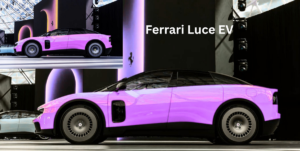
This is far more than a simple internal combustion engine swap; it is a structural and philosophical reset of Ferrari’s design language, aerodynamic parameters, and cabin ergonomics. Developed under a secretive, five-year creative alliance with LoveFrom—the design collective spearheaded by legendary former Apple chief designer Sir Jony Ive and Marc Newson—the Luce completely throws out the traditional visual aggression of the Italian brand in favor of a smooth, fluid, and deeply polarizing aesthetic.
The LoveFrom Aesthetic: A Radical Cab-Forward Silhouette
By removing the packaging constraints of a traditional front-mounted V12 or mid-mounted V8 engine, LoveFrom’s engineering team executed a radical cab-forward architecture. Stretching 197.9 inches in length with a low-slung 60.8-inch roofline, the Luce cuts an unconventional profile on the tarmac, rolling on massive staggered wheels (23-inch front, 24-inch rear).
The exterior relies on a continuous, sweeping teardrop glasshouse where the windscreen flows directly into a steeply sloped nose assembly. Airflow is managed via a floating front aerodynamic wing that routes air under the body and out through active conveyance channels. While Ferrari claims this ultra-fluid shell reduces overall aerodynamic drag by 25 percent compared to legacy front-engine platforms, the design has already polarized traditionalists, with early critics comparing its rounded profile to a “smooth bar of soap” rather than a sharp Italian thoroughbred.
Inside the Cabin: Rejecting the Touchscreen Apocalypse
While the exterior embraces the aerodynamic future, Jony Ive’s influence inside the cabin marks a severe, deliberate rebellion against modern automotive screen layouts. The Luce arrives as Ferrari’s first-ever five-seater grand tourer, utilizing rear-hinged coach doors and a functional rear liftgate.
Instead of dominating digital panels and sweeping touch interfaces, the cockpit relies completely on analog, precision-machined physical controls:
-
Integrated Metal Dials: The driver’s instrument cluster features three physical metal-ringed dials housing high-density digital OLED displays inside them. This mechanical assembly moves in tandem with the adjustable steering column.
-
Tactile Steering Controls: Traditional transmission paddles have been repurposed as mechanical energy-regeneration toggles. Pulling a “downshift” paddle instantly increases regenerative braking load to settle the chassis into a corner, while an “upshift” opens full battery discharge on exit.
-
Solid Glass Ignition: The vehicle activation sequence is driven by a solid glass physical key containing an embedded E Ink state-display, which slots into a heavy mechanical center console dock.
Performance Metrics: Managing the EV Weight Conundrum
The Luce is built upon an advanced 880-volt electrical architecture utilizing four independent electric motors—assigning a dedicated powertrain unit to each individual wheel for infinitely variable torque vectoring.
| Performance & Engineering Parameter | Technical Specification / Metric Value | Operational Context & Benchmark |
| Combined System Power Output | 1,035 Horsepower (772 kW) | Exceeds Ferrari F80 Hypercar baseline |
| Powertrain Bias Allocation | 831 HP Rear / 282 HP Front | Maintained rear-wheel-drive sports dynamics |
| Acceleration Metrics | 0–62 MPH (100 km/h) in 2.5 Seconds | 0–124 MPH achieved in 6.8 seconds |
| Maximum Governed Velocity | 193 MPH (310 km/h) | Includes temporary 54-HP overhead boost |
| Battery Capacity & Range | 122-kWh Structural Lithium-Ion | 330 Miles (WLTP) / Est. 280 Miles (EPA) |
| DC Fast Charging Speed | 350 kW Maximum Input Capability | 10% to 80% State-of-Charge in 20 minutes |
Despite utilizing a 75 percent recycled aluminum spaceframe, the sheer volume of the structural battery pack pushes the Luce’s curb weight to an immense 4,972 pounds (2,260 kg). This makes it roughly 1,500 pounds heavier than a V12-powered 12Cilindri. To mask this mass, Ferrari deployed its third-generation active suspension matrix—derived directly from the F80 hypercar program—alongside a central Vehicle Control Unit (VCU) that samples and recalculates lateral and longitudinal dynamics 200 times per second.
Engineering the Analog Soul Without Synthetic Fluids
To combat the acoustic isolation typical of premium electric vehicles, Ferrari engineers completely banned artificial synthesizer noise or digital speaker tracks. Instead, a specialized physical accelerometer is hard-mounted directly to the rear motor casing to capture the raw mechanical harmonics and high-frequency rotations of the drivetrain.
This acoustic vibration is dynamically equalized and physically amplified through the chassis structures—a process Ferrari compares to an electric guitar pickup. This delivers an authentic, evolving mechanical soundtrack inside and outside the vehicle, perfectly mapped to the e-Manettino’s Range, Tour, and Performance drive profiles.
The Ferrari Luce is slated for initial customer deliveries in Europe in late 2026, with North American dealership arrivals scheduled for Q2 2027. By handing a blank sheet of paper to Apple’s design royalty, Ferrari has taken an incredible financial risk, betting that minimalist tactile luxury and mechanical purity can define the future of high-end electric mobility.